
Why Do We Keep Coming Back to the Fingers Data Set?
October 26, 2026

If you've taught with CourseKata, you've probably noticed that the somewhat boring and inconsequential Fingers dataset makes frequent appearances throughout the textbook. And that's intentional!
There's value in exploring a variety of datasets, especially those that connect to students' interests and real-world questions. So that's what we do with our jupyter notebooks and data investigations that examine consequential data about civic responsibilities, business/careers, and interpersonal relationships. But there's also value in returning to something familiar. Reusing a simple, anchor dataset allows students to build on what they already know, explore increasingly complex statistical concepts, and focus on learning new tools without having to familiarize themselves with new contextual information every time.
But do students recognize these benefits?
We asked students: "Why do you think that the thumb length variable from Fingers is being used repeatedly?"
Here's a graph of the most common types of responses.
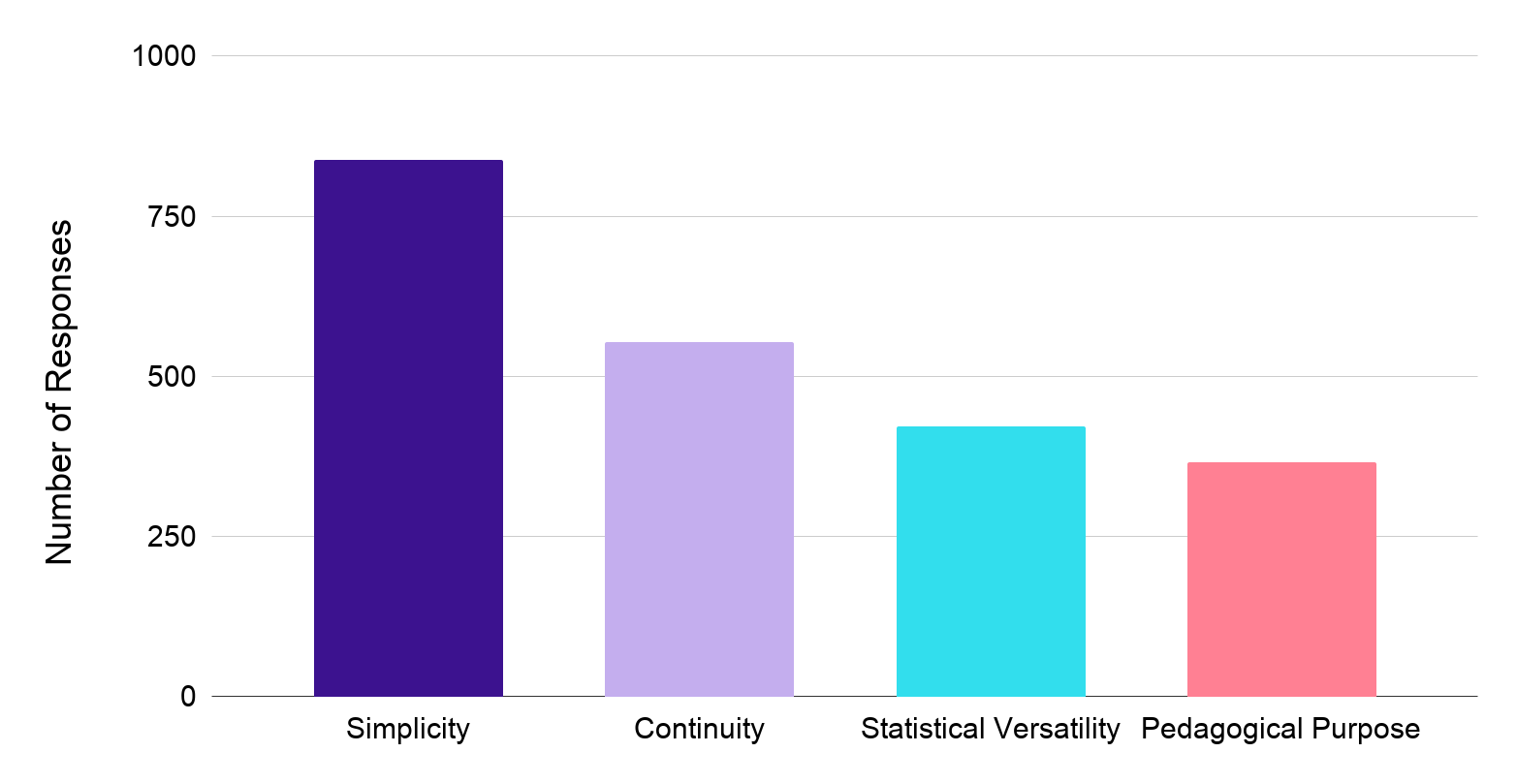
The most frequently mentioned reason was simplicity (e.g., “I think the thumb length variable is used repeatedly because it’s a simple, consistent example that helps us practice different statistical ideas. It’s something everyone can relate to”), followed by continuity (e.g., “I think it’s being used repeatedly so we can expand on the concept with a topic that are familiar with in order to solidify what we are learning.”). Students also frequently recognized the statistical versatility of the variable (e.g., “I think that the repetitive-ness of using the same data frame and variable is to illustrate all of the different ways you can go about representing and experimenting with a single data set. There’s a lot of information you can pull from one variable in one data frame.”) and the pedagogical purpose behind reusing the same dataset (e.g., “To keep the context constant so I can focus on learning new tools, not new data. Reusing a familiar dataset lowers my mental load, makes results comparable across chapters, and helps me build intuition about distributions, relationships, and model tweaks over time”).
These responses suggest that students aren't simply noticing the repetition. Many are recognizing the instructional reasoning behind it: a familiar dataset gives them a foundation for exploring new statistical ideas, making connections across chapters, and focusing on what they're learning rather than having to navigate an entirely new context each time.
Familiarity and variety both have a place
Of course, variety matters, too! New datasets can introduce students to different questions, contexts, and applications of statistics. That's why CourseKata takes both approaches: returning to familiar datasets like Fingers while saving the other more fun or intriguing datasets for in class time. In fact, we've asked students what topics they would like to explore further using data. Here are some of the things that came up.
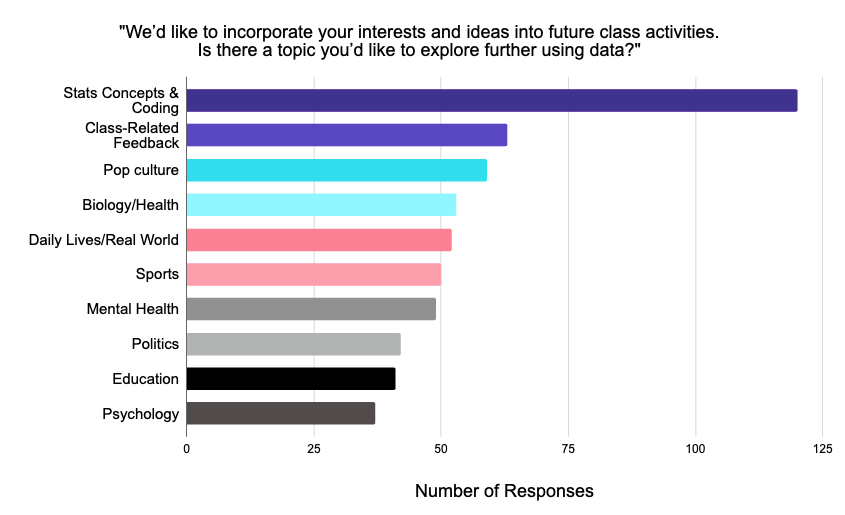
So we've added into our in-class materials data about Mr. Beast, parasites, the impact of laptop use on students, NBA/MLB/NFL, measuring happiness with instagram posts, voting, Pokemon, and more!
The takeaway? We already know why we return to Fingers. We wanted to know whether students recognized the value, too – and their responses suggest that many do. It's an encouraging reminder that thoughtful instructional design can help students see not only what they're learning, but also why we're teaching it this way.