
CourseKata Research Recap 2025
December 17, 2025

This year, our research confronted a persistent problem in education: learning science and classroom practice rarely overlap in ways that meaningfully help teachers. Researchers publish papers that almost no instructors read, while teachers face daily instructional challenges that research agendas rarely address. To bridge this gap, we focused not only on generating findings, but on strengthening the community structures that allow research and teaching to inform one another. This work led us to: (1) organize a CourseKata symposium on Bridging Research and Practice Through the Better Book Approach; (2) co-design a summative performance assessment now used by instructors, curriculum developers, and researchers; and (3) align our annual researcher convening, DREAM, around the theme Doing Research on Education that Actually Matters. By grounding our research in the classroom challenges that occupy instructors’ time and attention, we advanced our mission of creating more equitable, effective learning experiences and a continuously improving, theory-driven curriculum.
Conference Spotlight: CourseKata Symposium at WPA
Bridging Research and Practice Through the Better Book Approach
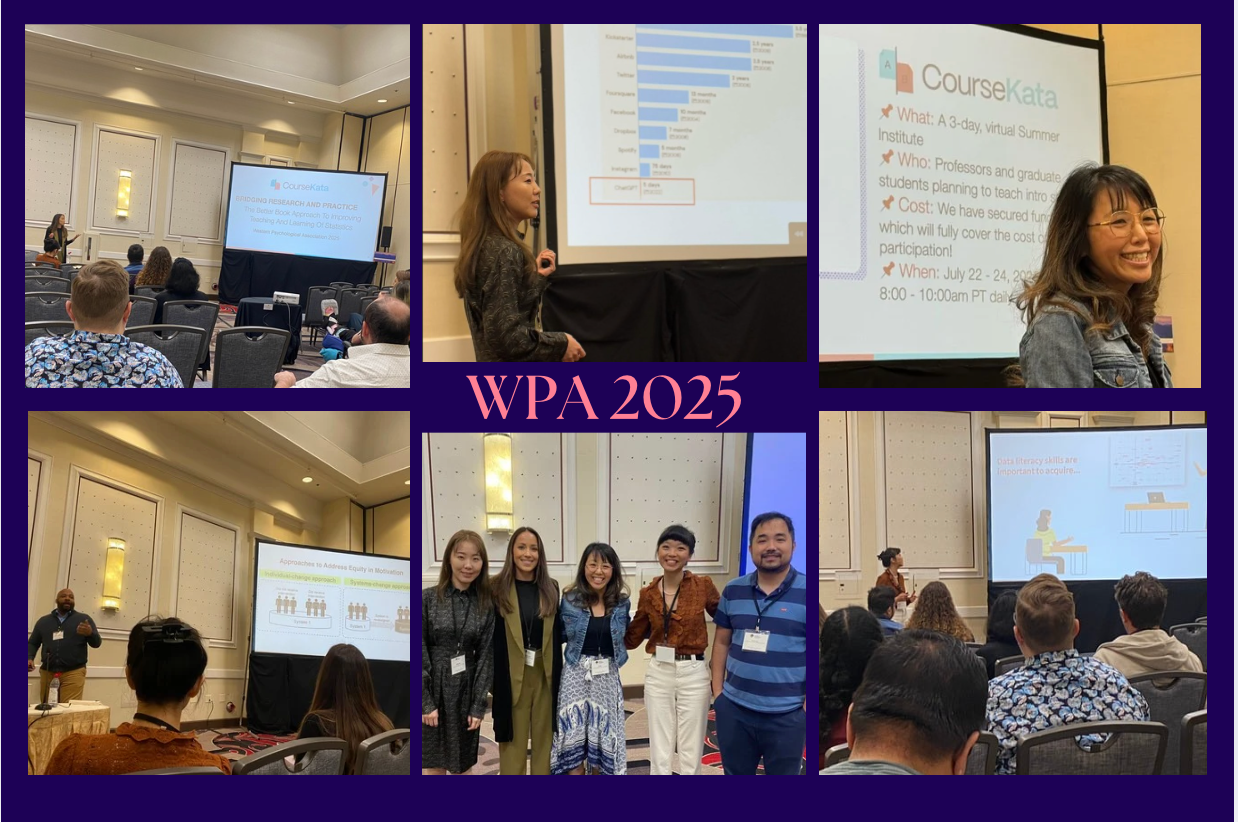
One of the highlights of 2025 was our CourseKata symposium at the Western Psychological Association (WPA) conference, where CourseKata had a 90-minute session titled “Bridging Research and Practice Using the Better Book Approach to Improving Teaching and Learning of Statistics.” Organized and chaired by Claudia Sutter with Ji Son as the discussant, the symposium showcased how CourseKata brings psychological theory, empirical research, and classroom realities together into a continuous improvement system.
The symposium opened with a foundational question: How can we use learning science to meaningfully transform how statistics is taught and learned in real classrooms?
Rather than answering this question abstractly, the heart of the symposium was in the work of four research teams from four institutions. Their projects – rooted in CourseKata’s data infrastructure – offered concrete examples of how the Better Book approach brings theory into practice. Each provided a different lens on how research can generate insights that immediately shape curriculum design, making research actionable and demonstrating how diverse methods and perspectives can produce insights that directly influence curriculum improvement:
- Dr. Matt Jackson (Cal State LA) – Equity-oriented curriculum redesign rooted in pulse check data
- Alice Xu (UCLA) – Measures of learning and metacognition taken by real students as well as AI agents
- Dr. Judith Fan (Stanford) – Mindset, cognitive processes, and students’ interpretation of visualizations
- Dr. Guanyu Hu (UT Houston) – Engagement log data as a window into learning trajectories
WPA 2025 offered a powerful affirmation of CourseKata’s model:
- Real improvements in learning require collaborative systems, not isolated studies
- When researchers and teachers work together, curriculum becomes a living, evolving tool
And perhaps most energizing of all? We had the opportunity to connect with CourseKata instructors face-to-face–strengthening the relationships that make this work possible.
What’s new? CourseKata Performance Assessment
Measuring What Really Matters
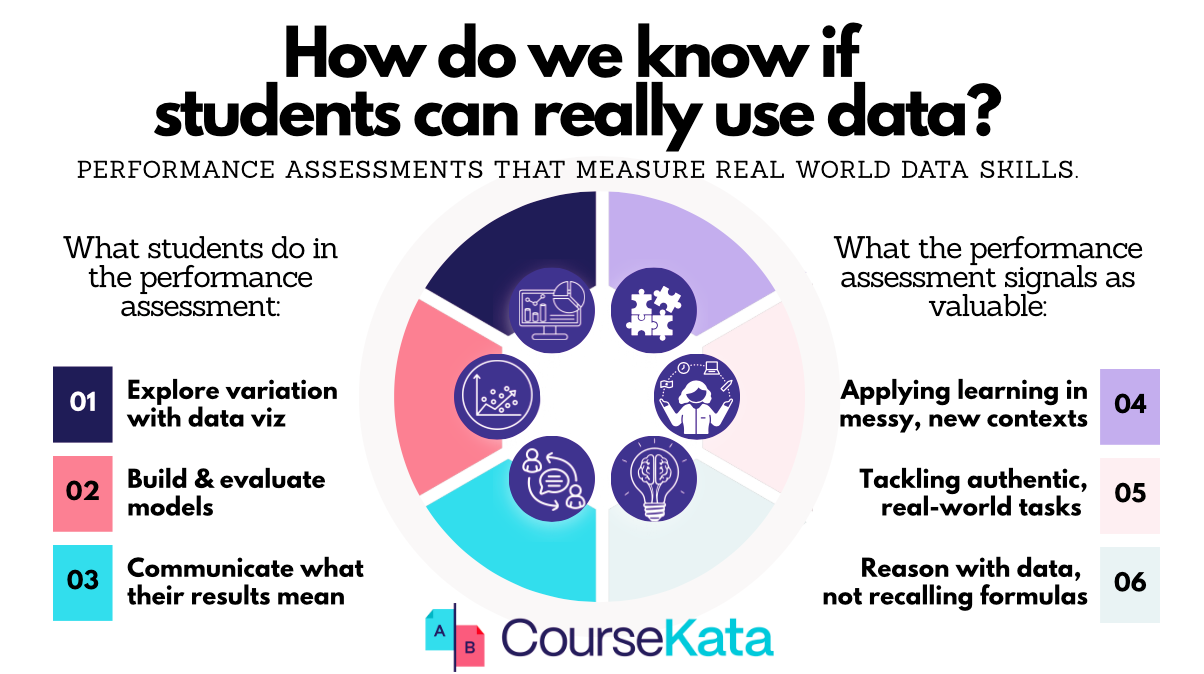
This year marked a major milestone: the development and pilot of CourseKata’s summative performance assessment, co-designed with teachers to measure deeper learning, reasoning, and transfer, not just recall. Our main question is: Can students use data to answer real questions?
The one-hour performance assessment (following Chapter 9 of the ABC textbook) asks students to:
- Explore variation using visualizations
- Build and evaluate statistical models
- Interpret results and communicate conclusions
This assessment communicates to students that real learning means:
- Transfer – applying knowledge in unfamiliar, messy contexts
- Authenticity – doing tasks that mirror real data work
- Reasoning over recall – making decisions, interpreting outputs, articulating meaning
In an era of AI, this matters more than ever. If tests only require polished answers, AI will do the work for students. But if assessments require curiosity, sense-making, and judgment, students must engage deeply. Check out our blogpost on assessments here.
DREAM 2025: Doing Research on Education That Actually Matters
In November, CourseKata hosted its third DREAM event - DREAM 2025 – our annual convening dedicated to deepening research–practice partnerships and supporting a community of educators and researchers committed to improving statistics and data science education. Building on the momentum from previous years, DREAM 2025 centered on a theme that sits at the core of CourseKata’s mission: How do we conduct research that is useful, actionable, and grounded in the real work of teaching and learning?
Why DREAM Matters
We reflected on a challenge that shapes education broadly: the gap between learning science and real classroom practice. Research is often conducted far from the realities teachers face every day, and classroom wisdom rarely reaches the research world. DREAM is an intentional space where these communities come together in a shared R&D effort.
Lightning Talks: Research with Purpose
Five research teams kicked off the event with 5-minute lightning talks–each addressing two guiding prompts we asked presenters to consider (1) Why should a teacher be interested in your research? And (2) Why should other CourseKata researchers care about your findings?
A Collaborative Vision: Research That Serves Teachers
Breakout discussions then focused on instructional pain points, what teacher-relevant research looks like in practice, and how to build sustainable researcher–instructor partnerships. These conversations surfaced concrete priorities, including designing studies around real classroom challenges and improving pathways for sharing insights beyond traditional academic outlets.
Looking Ahead
DREAM 2025 served as a powerful reminder that the heart of CourseKata’s research is its people. Whether joining from a high school statistics class, a university psychology department, or a research lab, participants share a commitment to improving learning experiences for students everywhere.
Check out our DREAM 2025 Blogpost here: https://www.coursekata.org/news-announcements/dream-2025-doing-research-on-education-that-actually-matters
Researcher Spotlight: Icy Zhang
We’re excited to spotlight Icy Zhang as our Coursekata researcher this year!
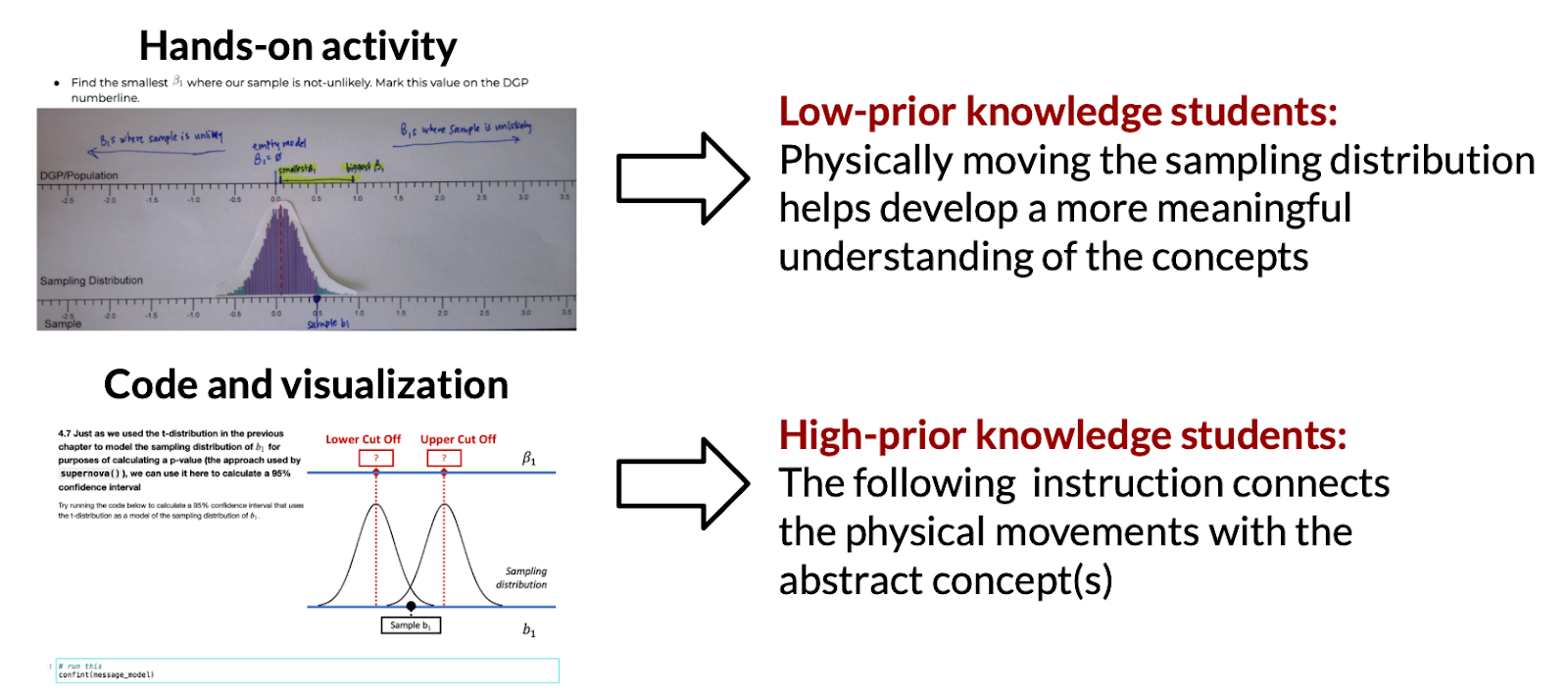
Using CourseKata materials, Icy conducted a longitudinal in-class intervention in 2024 to evaluate the efficacy of two types of embodied pedagogies used to teach core concepts in statistics and data science (e.g., randomization, bootstrapping, statistical models, sampling distribution and confidence interval) in a more physical and concrete way. The paper is just accepted to the Journal of Educational Psychology (preprint link).
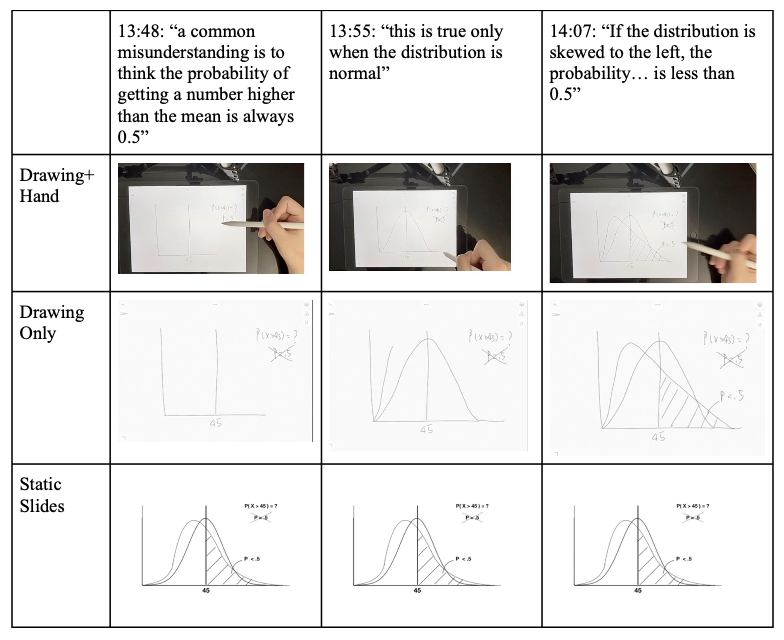
In another project Icy and her team investigated what intro stats students understand and misunderstand about normal probability distributions and explored ways to better teach the normal probability distribution.They developed instructional videos that used hand drawing to help students develop a more concrete and intuitive understanding of the normal probability distribution. Check out the screenshots from the three experimental conditions below. This study is now published in Memory & Cognition (https://link.springer.com/article/10.3758/s13421-024-01526-7).
To learn more about Icy’s work, go here: https://edpsych.education.wisc.edu/fac-staff/zhang-icy/
Looking Ahead to 2026
Reflecting on 2025, we are reminded of the impact of a community working together – teachers, researchers, students, and developers all contributing to a shared vision of what modern statistics and data science education can be.
With new assessments, new tools, strengthened partnerships, and powerful insights from the classroom, we’re entering 2026 with momentum.
Our commitment remains steadfast: Create a research-informed curriculum that improves continuously, equips students with real analytical skills, and fosters equitable learning experiences for all.
Stay Connected
https://www.linkedin.com/company/coursekata
https://www.facebook.com/coursekata/
https://x.com/coursekata